Monday, October 22, 2012


Video: Human Evolution Overview


This video explains the evolution of humans from animal species after the extinction of the dinosaurs. It shows a clear cut, or direct to the point relationship between humans and their animal ancestors. The theory of human evolution continues to be a controversial issue. Opposing views about where humans came from are still sizzling. There are many researches to prove or dispute each claim. The main point is, the answer to the question, "where do humans come from", still depends on one's personal belief.

The students will use this video to think critically about human evolution. They will analyze the facts presented in the video, and based on their own judgment, create an argumentative essay. As an extension activity, students will collaborate with other students who have similar argument, to discuss and write a persuasive letter to try to change the point of view of other students. 


Khanacademy. (2011, May 28). Human Evolution Overview. Retrieved fromhttp://www.youtube.com/watch?v=frE1rjhH77Y&playnext=1&list=PLC33E61908407139B&feature=results_main


Website: Mystery Skull Interactive


Ever thought to be a paleontologist? This website provides a virtual experience of examining a fossil skull to identify if it belongs to a given human species, or it is a new species. This website will develop the students' ability to analyze, and conclude based on text and visual evidences. 

The students will work in groups in using the  Mystery Skull Interactive website to create two skull models using synthetic clay. They will label the parts of their skull models, and write their descriptions, and comparisons. To make this activity more rigorous, students can conduct further research on the species of the skulls that they have chosen or created a model of, and write an expository essay or article. They can create a display of the skull models, and all the corresponding writings and research they have done. The students will be able to expand their knowledge by inquiring on  each other's work.

Smithsonian National Museum of Natural History. (n.d.) Mystery Skull Interactive. Retrieved from http://humanorigins.si.edu/evidence/human-fossils/mystery-skull-interactive
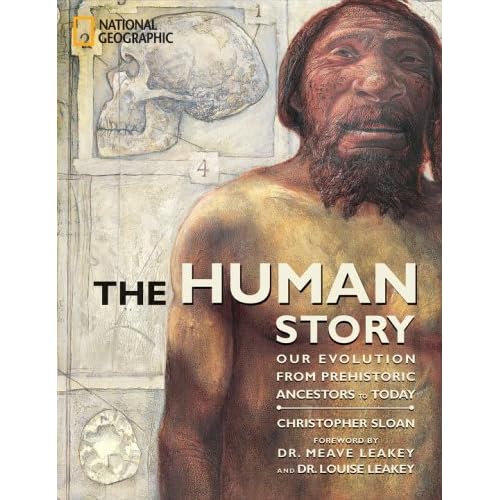


The following is based on the review by Steven Engelfried, Beaverton City Library: 
Grade 5-9--This excellent look at human development goes beyond the basic facts to examine the methods scientists use to learn about our past, the varied theories that have arisen from their work, and the historical and modern implications of evolution. While describing characteristics of various hominids over time, Sloan includes evidence that shows how tools, fossils, artwork, and geographical location have all added to our knowledge of early humans. When two theories conflict, such as the replacement model and the multi-regional model of evolution, the author gives balanced presentations for each side and good insight into how two contrasting ideas can both generate strong support. The final chapter considers the rapid advancements made by modern humans and presents some thought-provoking questions about the possible impacts of genetic manipulation. Illustrations on every page include full-color photographs and drawings, with a good mixture of fossil samples and imagined scenes from the daily lives of our ancestors. Despite the rich illustrative material, there is, unfortunately, no chart showing hominid lineage. Several one- and two-page spreads give closer looks at such topics as tool fossils, genomes, and binomial names. They are set apart from the narrative by either black or textured backgrounds. Overall, the visual presentation is appealing, and combines with the lucid, articulate text to make this a top choice on a needed topic.


The students will use this resource for a book study. They will formulate questions, and provide answers on certain topics in the book. They can also use this book for research, and expository writing. 

Leakey M., Leakey L. (2004, April 1). The Human Story: Our Evolution from Prehistoric Ancestors to Today. National Geographic Children's Books


This National Geographic article is mind boggling. It lays down the following predictions about human evolution:

1. Human evolution is dead. Survival of the fittest no longer spearheads evolution because medical advances allow the weakest to live and pass down their genes.

2. Humans will continue to evolve. Epidemics will increase the importance of genetic immune system, and will result in a human species with strong immune system. Others such as mental traits, and artificial selection using genetic technologies will also allow for continuous evolution.

3. Humans will achieve electronic mortality. Transhumanism will create the fittest human species because humans are able to cross biological limitations via technology (cloning, genetic enhancement, artificial intelligence).

4. New Era of Evolution awaits on Off-World Colonies. Humans are moving to habitable planets and new species will evolve due to their isolation from the world.


The students will be divided into four groups, and will be assigned to read, and discuss a prediction from this article. They will form contentions to support the prediction assigned to them. Then each group of students will present their contentions.

As an extension activity, the students can create their own predictions on human evolution.

Owen J. (2009, November 24). Future Humans: Four Ways We May, or We May Not Evolve. Retrieved from http://news.nationalgeographic.com/news/2009/11/091124-origin-of-species-150-darwin-human-evolution.html


Friday, October 19, 2012


Video :  Evidence of Evolution   

Who is related to who? This video explains  the Origin of Species that Charles Darwin and Alfred Wallace published together which lays down evidence of evolution. What roles did  biogeographyfossiland homology play in the study of evolution?  Was  DNA and its mutations one of the compelling evidences of evolution that Darwin discovered? This video provides clear and simple answers to all of these questions. 

Students will watch this video, and use it in a carousel brainstorming activity wherein groups of students will take turns in writing what they have learned about specific ideas from the video on chart papers.  Each group will be given opportunity to write on all of the chart paper by rotating after a given time which is ideally 2 minutes. The headings for this activity will be biogeography, fossil, homology, and DNA. After the carousel brainstorming activity, the students will post the chart papers on the wall, and discuss what they wrote. 


Bozemanbiology. (2012, March 31). Evidence of Evolution. Retrieved fromhttp://www.youtube.com/watch?v=cC8k2Sb1oQ8


Getting to know Charles Darwin is important in understanding his thinking or research. This website has Darwin's timeline, from his childhood, college years, voyage, married life, early research, after Origin of Species, to his old age. The great amount of topics about Charles Darwin also makes this website great. It has comprehensive information about the Beagle voyage, with maps and timeline; photographs of important places in Darwin's life; a collection of news about Darwin; people who influenced Darwin; and books and articles about Darwin.

The students will use this website in writing Charles Darwin's biography. 


About Darwin.com. (2011, September 4). Darwin's Timeline. Retrieved from http://www.aboutdarwin.com/timeline/time_01.html


Based on the review by high school biology teacher Richard Lord, posted 5/11/2010 on NSTA website, this book would be appropriate for high school and advanced middle school classes. Several branches of science are introduced, and the scientific process is well-illustrated with numerous examples of how scientists work, interpret evidence, make deductions, debate interpretations, and refine points of view. Many different technologies, from microscopic pollen analysis to DNA analysis, are explained as some of the ways used to unlock the secrets of the human past. The book also includes numerous illustrations, many in color, as well as suggestions for further reading, a timeline, a glossary, a bibliography, and identifications of all of the scientists mentioned in the stories of the hominin. 


The students will use this trade book in writing an argument piece through the point of view of different scientists. After writing the argument piece, they can extend the activity by conducting a debate to deliberate their opposing views. 


Rubalcaba J., Robertshaw P. (2010, February 1). Every Bone Tells a Story: Hominin Discoveries, Deductions, and Debates. Charlesbridge Publishing 


This recently published article which was referenced from an Oxford Journal, unfolds an interesting fact about the ancestors of mammals. It is a short but revealing article that the students will enjoy reading. 

As an activity for this article, the students will write comments about it, and discuss their comments in groups. 

Since the conclusion of the article provides for an idea to wonder about, ( But Galtier points out that the fossil record is incomplete. A large mammal ancestor that ultimately gave rise to all modern mammal groups, including the rodents, might simply have failed to fossilize),
students can also use the internet to search for answers and write their own article about it. 


Marshall M. (2012, October 7). Mammals' ancestor were not as puny as we thought. Retrieved from ww.newscientist.com/article/dn22343-mammals-ancestor-was-not-as-puny-as-we-thought.html


Friday, October 5, 2012

More on evolution: October 5, 2012


Videos: The evolution of the peppered moth

              The evolution of the hummingbird

For many years, a number of studies has been made by scientists and biologists following Darwin's theory of evolution through natural selection. The following videos show the evolution of the peppered moth and the hummingbird. These videos show easy ways to understand how creatures can evolve over a period of time to adapt to their environment. 

Learn how the dark-colored moths lived and flourished, and how the hummingbirds eventually got their long bills. Evolution through natural selection is an amazing topic, and these videos provide clear, and simple explanations using the peppered moth and the hummingbird as examples. 


Using both of the above video clips, students will work in groups to identify and explain the similarities and differences of  the evolution of the peppered moth, and the hummingbird. They will use a venn diagram in organizing their ideas. 

They will also create their theory on how a particular animal of their choice can evolve 20 or more years from now. They will create images of that particular animal, how they look like today, and how they think they will look like in the future. Students will identify or create environmental forces that can force their chosen animal to change or evolve. They will create  their own book that contains all of these information. 


Beast636. (2009). Evolution of the Peppered Moth. Retrieved from http://www.youtube.com/watch?v=LyRA807djLc

jo3y2fly. (2011). How Does Evolution Really Work? A Natural Selection. Retrieved from http://www.youtube.com/watch?v=vgIm6i-Olc4


 This website has an interactive game for students in learning about evolution.  It has an introduction to natural selection, and a survival game where students can create theoretical species that can survive a million years based on Darwin's rule of natural selection. It is a fun way to study about evolution. 

After exploring this site, students can write a descriptive narrative about the theoretical species they created using the interactive game. They will describe the physical and adaptive characteristics of their species, their environment, and how they can or cannot survive a million years. 


Trade book: 


Based on the review by professor Gerald Skoog posted November 21, 2005 on the NSTA website, this trade book emphasizes the power of evolution in explaining the nature and history of life. It is written for high school students and has a high density of informative illustrations, photos, and graphs, which interact with the text. Relevant questions are embedded in the text, and key ideas, quotes of scientists, referrals to information and activities are on an accompanying CD-Rom and teacher guide. Prompts for student actions are placed in the margins. Anyone searching for a book that depicts evolution and the nature of science in an understandable and informed way should access this book.

The students can use this book as one of the resources in writing an expository essay about the theory of evolution and natural selection. 


Corporate Author. ( 2005). The Nature of Science and the Study of Biological Evolution. NSTA Press


Article: 


This article from Science Daily reveals very recent findings on how insects can affect the plants' evolution through natural selection. It is a very informative article that proves of evolution as a continuous process, as scientists still discover different kinds of species changing to adapt to their environment. 

Students will read this article in groups of  four, assigning specific paragraph or paragraphs to each member. Each student will take note of the important points in their assigned part of the text. The group will discuss each other's  work, and will come up with a summary of the article. 


University of Toronto. (2012, October 4). Insects a Prime Driver in Plant Evolution and Diversity. Science Daily. Retrieved from http://www.sciencedaily.com/releases/2012/10/121004141745.htm